Foreword
Has it - or better said - it has happened that the implementation of many – or any – project in your company has begun with a sound rationale, accepted objectives, motivated stakeholders, defined budget, and a strict timeline; and ends up under a worn environment, with surfaced cultural and social rooted problems, uncertainties of its real practicality, different results, and above time and budget constraints?
Then...
Of course, it is not the first.
Of course, it still happens.
Hopefully it will not happen; or at least it will, to a manageable extent.
To make things spicier. There is a c-suite officer defined to artfully steer the science and methodologies to manage projects. Managing projects is the core study and practice of countless people, teams, and companies. It is a worldwide effort that searches for the way[s] to harmonize expectations, resources, operations, uncertainties and constraints, to efficiently close the gap between objectives and outcomes. All in all, while keeping one’s sanity in check.
This forewore serves to lay a common ground on the why, the context, for these following words. This article, and the others to come, have the objective to complement, to give additional tools, for better managing from the perspective of the most interesting and impact generating activity for the company: Strategy.
And what better that the world of projects to set the scene.
If well implemented, consistent through time, universal, based on strong principles, and dynamic, strategy will provide the bases for projects that are fluid, efficient, resource managed and positive-resulted. It is the company’s strategy that drives all actions, assets and corporate culture to be better suited for project-mode operations that deliver higher bottom-line results.
To start, the baseline: Strategy is about the decisions (what to do and what not to do) that keep the company targeting the results expected by its owners through time. The past provides information, the presents tests operations and assumptions, and the future, well there is the dilemma.
The future proposes countless possibilities that the strategist must turn into a finite, manageable set of possible scenarios, to consciously steer the wheel. Therefore, it is paramount to be aware that strategy, well done, takes time. To keep time as an ally, these scenarios have to be as focused, value-generators and holistic as posible.
Preamble
In its first stages, business-people should source information around its value offer: market behavior, value chain, internal operations, financial results, market and operational trends, partners, etc. This is not a once-done task. Carefully organize and follow up on this information.
Now, how to extract value from a vast quantity of information depends on various aspects, mainly consistency, experience and intition, or industry knowledge. There is a myriad of other methods to find insights. However, for entrepreneurs or small to medium sized businessmen, following Michael Porter’s frameworks, PESTLE analysis, scenario analysis, stakeholders’ analysis as well as cash flow analysis should be a strong baseline.
From this moment on, the task is to do as one dear and inspirational professor told me: list, list, list, group, group, group. The proposed process is set under the umbrella of the SWOT framework, yet it can be easily driven through different thought processes.
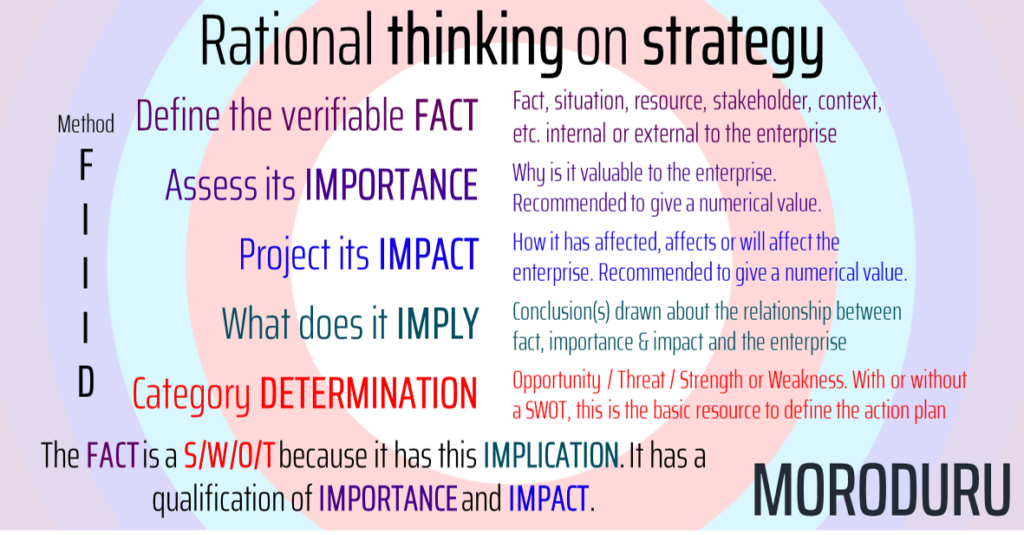
1st step – FIIID method (Fact – Importance – Impact – Implication – Determination)
Once you found the methods or sources of reliable information:
1. Define the verifiable FACT
Make a list of internal and external, preferably verifiable and measurable:
- Facts
- Agents
- Stakeholders
- Situations or circumstances
- Resources
They all have a higher level of with the company. It is important that each fact is clearly stated.
2. Assess its IMPORTANCE
For each item in the list, assess how valuable it is for the company. For example, for a tire manufacturer it is more important its network of retailers and wholesalers than its flagship stores. There is more value in spreading geographically rather than force customers to incur in the expense of extra resources by going to specific places.
Give a numerical value to each importance. For example, from 1 to 5, being 1 the least important and 5 paramount for the company. This will be useful in later stages.
3. Project its IMPACT
Again, for each item in the list, analyze how the fact has had, is having or will have direct impact on the results – social, market, equity – of the company. Whichever is defined as the bottom line, each of the previous statements will affect the company’s market, cultural and financial fitness. For example, a long-lasting drought could hamper the whole supply of red roses for Saint Valentine’s Day. The impact on cash flow will be close to catastrophic.
Give a numerical value to each impact. For example, from 1 to 5, being 1 the lowest impact and 5 critical for the company. This will be useful in later stages.
Additionally, if you are evaluating scenarios, contexts, situations or facts, evaluate the probability of them happening (from 0 to 1), and multiply it by the impact.
4. What does it IMPLY
This is basically the most important part of the analysis and synthesis process. It corresponds to the conclusion [or conclusions] about the fact, its importance, its impact and the company. What can be concluded on the relationship of these four aspects.
When obtaining the implication or implications of each item in the list, insights will appear. They give a real perspective of the actual or future status of the company.
5. Category DETERMINATION
Once all items are properly evaluated, each implication – in case there is more than one implication for each item listed – is better understood under the SWOT framework: whether it is an opportunity/threat (external) or a strength/weakness (internal). The SWOT analysis framework will facilitate the process of divergence and convergence of strategy analysis and definition.
Define your strategic context
Once done, propose each item with its corresponding implication as follows:
“The FACT is a S/W/O/T because it has this IMPLICATION.
It has a qualification of IMPORTANCE and IMPACT.”
Now there will be a categorized list of many aspects that directly influence the future of the company. With this 1st process, the base information to develop a flight plan is settled. Subsequently, in the next article, all of them will be confronted with one another.
Considering that no shortcut should be taken and that this phase is critical in the strategic process, the outcome of the first stage will provide substantial insights on the diverse dimensions of the company, its surroundings and the road ahead.